


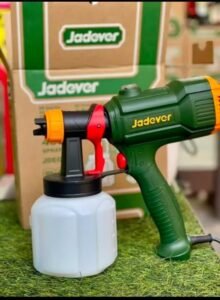
How to Use the Jadever 450W Spray Gun:
The Ultimate Guide to Painting a Perfect Job.
The Jadever JDEG1A45 Spray Gun can be added to your paint toolkit to improve the project time in the shortest way possible with a smooth and professional finish. With a powerful motor of W, a working current of 220-240 V/50/60 Hz, and the ability to work with materials of maximum viscosity of 100 DIN-s, this tool becomes an easy-to-use tool that addresses all types of tasks, such as fences, interior walls, etc.
This valuable resource guide will enable you to optimise the use of your equipment and also enable you to know the fine details of setting up, adjusting, and using paint like a professional.
How to Use a Paint Sprayer:
There is more than activating a trigger when using a paint sprayer. It is essential to maintain a proper balance of paint viscosity, airstream, and physical methodology to obtain an error-free coating. The Jadever 450W works by spraying the paint in minuscule droplets of paint and forcing them onto your surface. To achieve success, then you will have to keep a steady hand, keep a constant distance with your target, and always have the gun moving to avoid drips and runs.
READiness before spraying the paint.
Great paint jobs have occurred even before the machine is switched on. You have to ready your workspace and your paint.
Beautiful and Messy:
Take out the furniture of the room. Drop cloths are firmly taped to minimise damage to floors, and masking tape with plastic sheeting is placed over windows, trim, and outlets.
Check Viscosity:
The Jadever can give a maximum of 100 DIN viscosity. The speed of the paint flowing is measured using a DIN viscosity cup (included in most cases). In case it is taking the paint longer than 100 seconds to empty the cup, then add water (in the case of water paints) or the suitable solvent (in the case of oil-based paints) and thin the paint to the correct consistency.
Filter out the paint:
Take a fine mesh strainer and strain your diluted paint, trying to eliminate all the lumps or debris that have the potential of clogging the nozzle of the 450W motor. Test your aim on a piece of waste paper or a piece of wood by pointing your gun at it before you aim it at your completed project.
Find Your Distance:
When using the spray gun, it is set at the 6- to 8-inch distance.
Keep it Perpendicular:
Do not wring your wrist up and down. With your arm, maintain the nozzle in full parallel with the wall.
Trigger Timing:
It means that you move your arm before you pull the trigger and release the trigger before you stop moving your arm. This eliminates the possibility of thick deposits of paint at the end and start of each stroke.
How to Adjust Your Paint Sprayer:
The Jadever sprayer has few settings, and it enables you to control the application fully.
Flow Control:
Use the flow adjustment dial at the rear of the trigger to adjust the volume of paint leaving the gun to more or less. Start with a low flow rate and increase with familiarity.
Nozzle Orientation:
The front of the gun has an air cap, which you can turn to alter the form of the spray fan and either arm motion depending on this shape.
VERTICAL spray pattern in case of lateral spray of paint:
As you angle the air cap horizontally, then the gun results in the gun giving out a tall, narrow, vertical, shallow spray pattern. You have this as a setting when you require sweeping your arm across the sides (lateral spraying). This is very effective for painting broad areas of surfaces such as walls, fences, and big doors.
Vertical spray—horizontal spray superstar, patterns, V.K. FIT:
On the other hand, rotating the air cap in the vertical position will result in a wide, flat, horizontal spray pattern on the gun. This is a setting that you use when you want to move your arm up and down (vertical spraying). Select to paint tall and slim objects such as pillars, table legs, or upright siding with this pattern.
Spray walls and surfaces. How to paint any surface using spray.
When coating the walls without any dry point or heavy line, follow the 50 per cent overlap technique.
The Overlap Rule:
It is important to point the centre of your spraying gun at the bottom of the last streak you made. Passes that follow each other must overlap the earlier pass by 50%, and so on.
Work in Sections:
Break up huge walls into small parts of 3 feet by 3 feet.
Procedural:
Have a moderate, steady speed of your arm. Excessive haste results in a thin and smooth coat, whereas going too slow results in dripping of the paint.
Wall painting using our airless spraying.
Although the Jadever 450W high-volume turbine system instead of a high-pressure piston pump is applied, the thicker wall emulsions can still be achieved successfully with the condition that you do not exceed the 100 DIN viscosity range. Although spraying is a great method of coating interior latex or acrylic wall paint, one should always thin the paint according to the manufacturer’s instructions. High-power spraying penetrates the paint into the textured surfaces deeply so that the paint covers the drywall, brick, and masonry well in areas that rollers fail to reach.
Brushing vs. spraying:
Whether you are going to use a brush or a paint sprayer will always depend on the nature of the projects you are about to do.
Fashion Jadever 450W Spray Gun Classical Brushing:
Speed It finishes huge areas as quickly as 4 times. Slowest; every inch has to be pulled on.
A quality finish leaves one that is slick, glassy, and has no brush finishes. Usually leaves behind brush lapses, especially when using thicker paints.
Preparation Involves much masking and taping to avoid overspray. Very little pre-preparation is necessary; it needs no difficulty in slicing in organic form around the edges.
Material Usage Using a little more paint through atomisation and overspray. Extraction of high efficiency in terms of material use with zero air waste.
suits best on the walls, fences, cabinets, and louvred doors. Minor painting and fringe work.



Leave a Reply